
The Animal World Gallery in the National Museum of Scotland, Edinburgh
8 Revolutionary Scottish inventions and inventors
Discover the most famous Scottish inventions and inventors who have helped shape the modern world.
1. The fridge, 1748
Open a fridge door and feel that rush of cold air on a hot summer day. You reach in for a chilled drink without giving it a second thought how extraordinary the technology is.
It’s all thanks to William Cullen. In 1748, Cullen demonstrated his discovery of artificial refrigeration at Glasgow University by using a pump to create a small vacuum over a container of diethyl ether. However, Cullen’s marvellous creation received a cold reception, and it took many years before people began using fridges. Today, there are millions of fridges across the globe.
Discover some of the best ice-cream and gelato spots in Scotland and treat yourself to a scoop (or two) along the way.
Check out the best places to get ice cream in Scotland
Novelli, Burntisland
© Fife Council / Chris Watt
2. Kaleidoscope, 1816
Remember holding a kaleidoscope up to your eye as a child, turning it slowly and watching the colours collide and shapes multiply and shift into a new pattern?
This simple pleasure began with Scottish scientist Sir David Brewster, who invented the kaleidoscope in 1816. It creates a beautiful myriad of colours and patterns by bouncing light off angled glass lenses or mirrors and onto colourful bits of glass or other small objects.
Experience this science first-hand at Camera Obscura & World of Illusions in Edinburgh, where you can find lots of kaleidoscopes including the Giant Kaleidosphere. Make your way to the fourth floor at the Kaleido-Draw, where the whole family can enjoy creating unique, symmetrical patterns.
Head to Camera Obscura & The World of Illusions

Caleidoscopio alla Camera Obscura e World of Illusions, Edimburgo
© Camera Obscura & World of Illusions
3. The pneumatic tyre, 1845
Imagine travelling by horse-drawn carriage with every bump of the road coming straight through the wooden wheels.
Scottish inventor Robert William Thomson changed that experience. Although Ayrshire-born John Boyd Dunlop is often credited with the invention of the pneumatic tyre for his son's bicycle, it was Thomson of Stonehaven who developed the first pneumatic tyre for use in horse-pulled coaches.
Check out these fantastic experiences for a wheely good time!
- Knockhill Racing Circuit, by Dunfermline – get behind the wheel and feel like a Formula 1 driver as you take a spin in your very own race car.
- Landyachting with Blown Away, St Andrews – land yachting combines sailing and motor racing into one. Enjoy a fun day out at West Sands Beach in St Andrews, where you’ll be given a full demonstration on how to sail a land yacht.
- 4x4 Adventures Scotland, Loch Lomond – you’ll be given the keys to a Land Rover Defender helping you to tackle the most challenging terrains with a variety of experiences available.
Highland Safari, Perthshire
4. The pedal bike
Push down on the pedals and feel the bike gather speed as you glide along quiet forests and woodland trails, picturesque country lanes or dramatic coastlines.
It all started with Kirkpatrick Macmillan, a blacksmith from Dumfries who created the first pedal-driven bike, the velocipede. Since then, it has evolved into the modern-day bike that we know and love today.
Taking your bike to new places is an exciting and eco-friendly way to see Scotland. Kick-start your cycling adventures with these fantastic routes:
- John Muir Way, cycling day trips, East Lothian – the 134-mile (215 km) coast-to-coast walking and cycling route stretches from Helensburgh in the west of Scotland to Dunbar in the east.
- Kirkpatrick C2C, south Scotland – starting in Stranraer and finishing in Eyemouth, the route celebrates Scotland’s rich history of innovation and offers experienced cyclists 250 miles (402 km) of breathtaking landscapes, ruined abbeys and more.
- Round the Inner Forth – the 62-mile (100 km) route takes you on a whistle-stop tour around the Forth Estuary on a mix of quiet roads and traffic-free tracks.
Mountain bike presso il Glenlivet Mountain Bike Trail Centre
© Ed Smith
5. Colour photograph, 1861
If you look back at your favourite holiday photos, it's the colours that bring the memories so vividly to life, from turquoise sea waters to purple heather stretching across hills and deep green glens winding between mountains.
Often referred to as the ‘father of modern physics’, Scottish physicist James Clerk Maxwell is responsible for the world’s first colour photograph. In 1855, Maxwell introduced the three-colour method and conducted an experiment to show that all colours can be made by an appropriate mixture of red, green, and blue light. During a lecture in 1861, he revealed the first colour photograph of a tartan ribbon.
Colour photography makes it possible to take beautiful pics of Scotland. Whatever time of year you’re visiting, photos are a great souvenir to share and reminisce until you come back.
Discover Scotland's most iconic views and picture-perfect places
Turleum Hill, Crieff
© Crieff Succeeds / Damian Shields
6. Telephone, 1876
The telephone is probably one of the greatest Scottish inventions of our time. Keeping in touch used to mean waiting for a letter to arrive, or hearing someone's voice meant being in the same room.
Helping us to stay in touch is Alexander Graham Bell, who invented the first ever telephone. The initial idea stemmed from his mother and wife, who were profoundly deaf, and led him to experiment with hearing devices. He was later granted the first patent for the telephone in 1876.
- Scotland’s Secret Bunker, St Andrews – the bunker used to house its very own broadcasting studio with telephone switchboards during the Cold War.
- Barnton Nuclear Bunker, Edinburgh – a former Cold War-era civil defence facility where you can tour its preserved control rooms and communication centres.
- An iconic red telephone box in the village of Pennan, Aberdeenshire – it made its big screen debut in the film Local Hero and it’s still in service if you fancy making a call.

Cabina telefonica rossa a Pennan, Aberdeenshire
© VisitAberdeenshire
7. Television, 1926
The screen lights up, the picture comes into focus and suddenly a whole other world is in front of you – you're swept into the misty Highlands of Outlander, following the twists and turns of The Traitors, or stepping into the lavish world of The Buccaneers, all stories and moments happening miles away.
It’s all thanks to the inventor John Logie Baird, who demonstrated the first working television back in 1926. That’s not all, Baird also achieved the first transatlantic television transmission and is responsible for inventing the first colour television. Discover some of the most iconic film and TV locations, from St Ninian’s Cave which featured in The Wicker Man to the impressive Three Sisters in Glencoe seen in Skyfall.
Find Outlander filming locations
Discover Scotland as seen on the screen
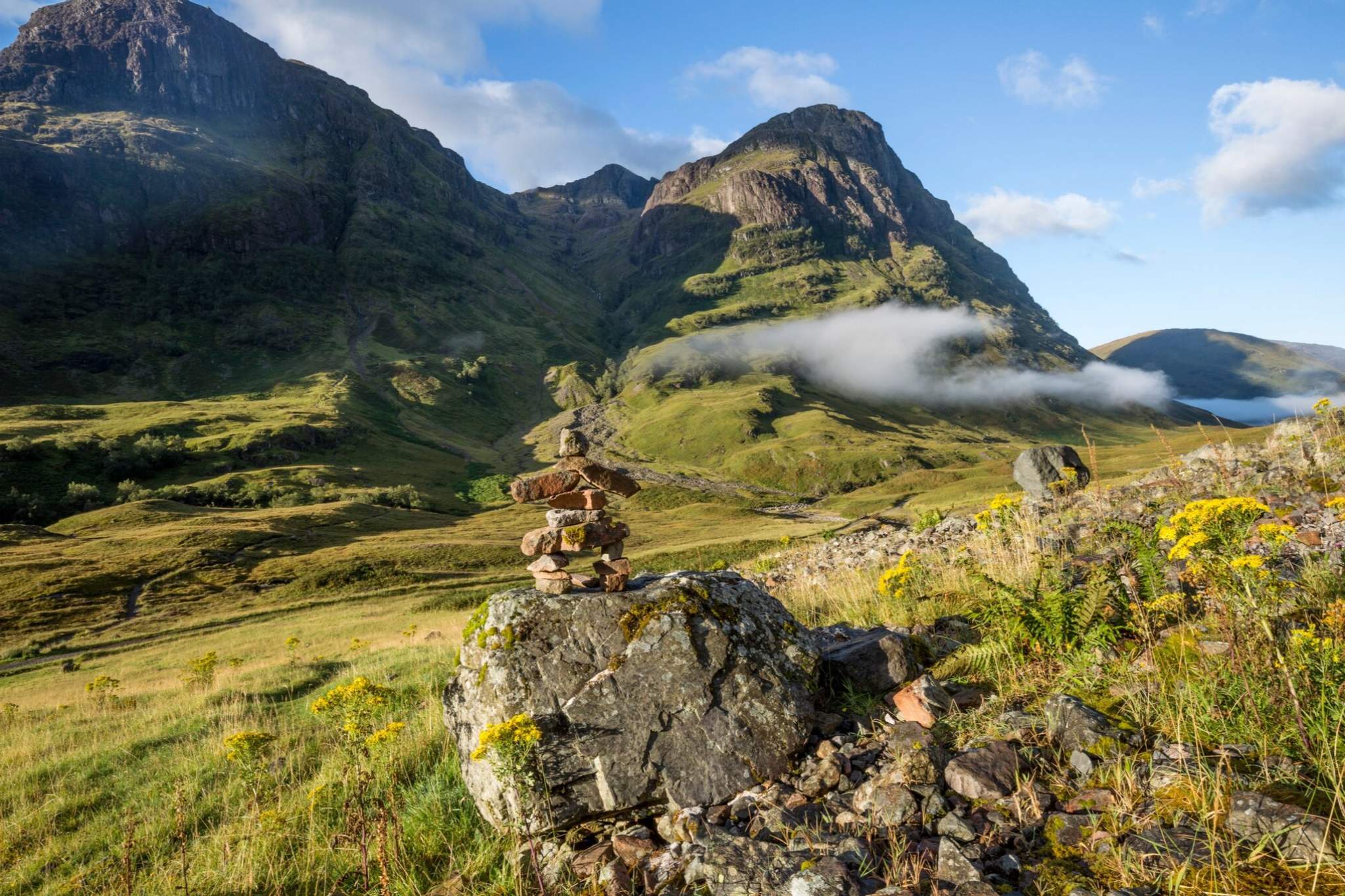
Le Three Sisters, Glencoe
8. Dolly the sheep (first mammal to be cloned), 1996
Behind the glass, she looks like an ordinary sheep. Soft, woolly and with curious, gentle eyes, looking as if she's about to wonder off to graze quietly across a Scottish hillside or field at any moment.
Yet this particular sheep has made a big name for itself in scientific history. Dolly the sheep became the first mammal to be cloned from an adult cell. Born at the Roslin Institute near Edinburgh, she was grown from a single mammary cell which contained all the information to create a whole new sheep. Her birth transformed our understanding of what was possible in genetics and was a revolutionary moment in modern science. Dolly died in 2003 but can be seen on display at the National Museum of Scotland in Edinburgh.
See Dolly the sheep at the National Museum of Scotland

Il National Museum of Scotland, Edimburgo
This list was created by VisitScotland to showcase a range of experiences. It isn’t ranked in any specific order.